 Top Trending
Two Organic Herbs From India, 300 Milligrams Each, in a Capsule the Maker Says to Take Four Times a Day: What "Whole Herb" Means Next to the Extract of the Trials, and Why a Bottle of Ninety Lasts Twenty-Two Days
Organic India's Memory capsules are the plainest herbal bottle in this category: organic bacopa and organic gotu kola, ground whole, 300 milligrams of each in a plant capsule, and nothing else. I read the panel beside the three bacopa trials in people over 55, which used the same number of milligrams of something different, read the one small gotu kola trial and the meta-analysis that followed it, did the arithmetic on the maker's own dosing chart, and read the return page, which is two sentences long and says no.

This is a paid advertisement. Sponsored by Organic India USA, LLC.
Leonard Hask is the pen name of this desk.
The customers quoted on this page are real; their reviews are public on the seller's product page and were read there on September 9, 2026.
I haven't met them and know nothing about them beyond what they wrote.
The small photos beside their reviews are illustrations, not the reviewers.
The seller's review system marks some reviews as incentivized, and those are marked the same way here.
Everything about the bottle, from the two lines on the panel to the return page, comes from the seller's own label and pages, read the same day.
I grew up with a grandmother who kept herbs in jars and a clinician who kept them in a drawer, and I've spent my adult life trying to tell which was right.
This bottle is the grandmother's kind.
Two herbs, both grown organically, both ground whole and put in a capsule, with a panel short enough to read without your glasses.
And the honest question about it isn't whether the herbs are real.
They are.
It's whether 300 milligrams of a ground-up plant is the same thing as the 300 milligrams of standardized extract that the trials used, because it isn't, and the label doesn't pretend it is.
So that's what this page is.
Two herbs, three trials and a meta-analysis, one dosing chart with a surprise in it, and a return page that says no.
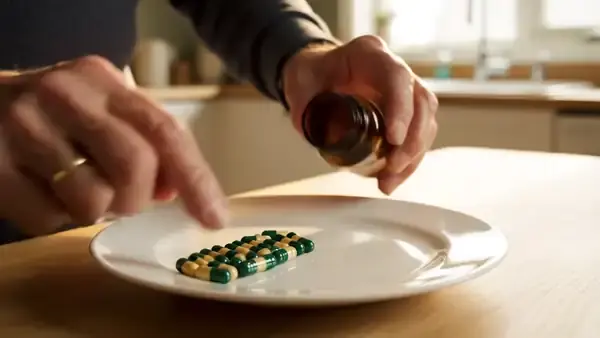
Two capsules, with food and water, twice a day according to the maker's chart. Every number on this page is for two capsules, and the arithmetic at the end is for four.
Here's what the bottle is.
Memory, from Organic India, the trade name of Organic India USA, LLC, a company with its customer-care office in Boulder, Colorado, whose herbs come from certified organic farms in India.
A dark amber bottle of ninety vegetarian capsules.
The panel, in the seller's order: organic bacopa, whole herb, 300 milligrams; organic gotu kola, whole herb, 300 milligrams.
Then the capsule: organic pullulan, which is a plant-fermented film.
Nothing else.
No fillers, no flow agents, no vitamins, no blend.
I did what I always do.
I read the label before the listing.
I read the trials behind each herb, at the doses and in the forms they actually used, in people as old as I am when such trials exist.
I read the maker's own "How to Use" chart, which says something the front of the bottle doesn't.
I read all twenty-two reviews, and the flag the seller's own system puts on eight of them.
And I read the return policy, which took eleven seconds.
What I found is the cleanest herbal label I've read this year, from a company with a phone number and a real certification, whose two herbs are printed at the weight of the trials but not in the form of the trials, whose bottle lasts three weeks at the maker's dose, and which can't be sent back.
One more thing before the first line, because most of you got here from one of our own advertisements.
Those ads talk about a boxed cereal, three foods, three drinks, and three words or phrases a man is supposed to be able to say.
None of that is in the capsule, and I won't pretend it is.
It's on this page, in its place: the cereal, the drinks and the word test are the seventh line, and the honest version of every headline we run is in the guide linked at the foot.
Line one · The bottleAn Amber Bottle, Ninety Capsules, and a Panel With Two Lines
This is what's on the counter.
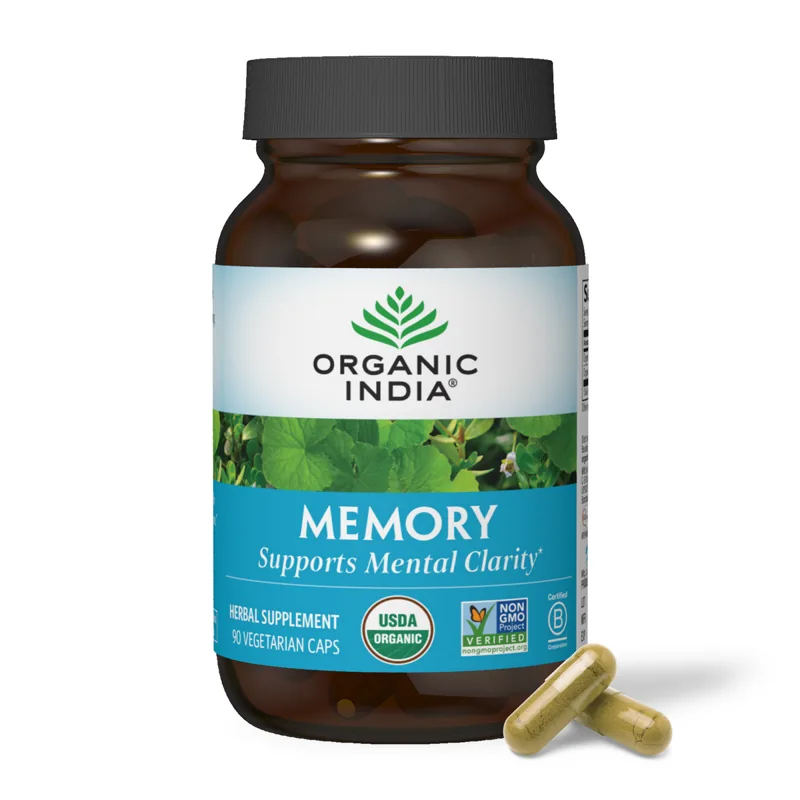
A dark amber bottle with a black cap and a pale blue label with a line drawing of a leafy plant on it.
The front says Memory, then a three-word promise with the little dagger every supplement in America carries, then Herbal Supplement, 90 Vegetarian Caps, and three seals: USDA Organic, Non-GMO Project, and the B Corporation mark.
The back is the panel, and I'll read it to you whole, per two capsules:
Organic bacopa, Bacopa monnieri, whole herb, 300 milligrams.
Organic gotu kola, Centella asiatica, whole herb, 300 milligrams.
Other ingredients: organic pullulan capsule.
Servings per container: 45.
The maker's "How to Use" chart, from the listing: two capsules, twice daily, with food and water; consult your health practitioner; and two tips, to try it in the evening and to start with once a day for two weeks and adjust.
Two herbs and a capsule.
That's a label a man can hold in his head, and it's rarer than it should be.
Line two · BacopaThree Hundred Milligrams of Whole Herb, and Three Trials That Used Three Hundred Milligrams of Something Else
The herb the bottle stands on, the best trials in people my age, and the one word that separates them.

Bacopa monnieri is a small creeping plant of wet ground in India, used there for centuries under the name brahmi, and it's the one herb on this panel whose trials were done in people my age.
Fifty-four healthy adults aged 65 and older took 300 milligrams a day of a standardized extract, or a placebo, for twelve weeks, and the bacopa group did better on delayed word recall. [1]
Ninety-eight healthy adults over 55 took the same 300 milligrams for twelve weeks, and the bacopa group did better on verbal learning and retention. [2]
A 2014 meta-analysis pooled nine trials of standardized extracts, 518 people, taken for at least twelve weeks, and found faster performance on two measures of attention and processing. [3]
Three hundred milligrams.
The same number as this label.
But read the words beside it in each trial: a standardized extract.
An extract is what you get when you soak the herb and concentrate what comes out, and "standardized" means the maker measured the plant's active compounds, the bacosides, and adjusted the extract to a fixed percentage of them.
This label says "whole herb": the plant, dried and ground, with no extraction and no bacoside figure.
Same weight, different thing.
A gram of ground herb carries a fraction of the active compounds that a gram of a concentrated extract does, and this label doesn't say what fraction, because it wasn't measured that way.
Bacopa at 300 milligrams of whole herb matches the trials in number and not in kind. It's the plant the trials studied, in the form your grandmother would have recognized, at a strength the label doesn't state.
I want to be fair to the herb, because this is the part of the page where it's easy to be unfair.
The whole plant is what people in India have taken for centuries, and the extracts of the trials came from it.
There's just no trial of the ground whole herb at 300 milligrams in people over 55, and the label makes no claim of one.
Line three · Gotu kolaThree Hundred Milligrams, One Small Trial at Seven Hundred and Fifty of an Extract, and a Meta-Analysis That Found No Effect on the Tests
The second herb, its two names, and the honest size of its evidence.
Gotu kola, Centella asiatica, is a small creeping plant of wet places across South Asia, eaten as a green in Sri Lanka and used for centuries in Ayurveda, where it too is sometimes called brahmi, which is why the seller's listing uses that name for both herbs.
It's the second of the pair the listing calls its two brain herbs, in words this page won't repeat.
The trial worth reading is small.
Twenty-eight healthy older adults took an extract of gotu kola for two months at one of three doses, or a placebo, and the highest dose, 750 milligrams a day, was associated with better working-memory performance and higher self-rated alertness. [4]
Two months, 28 people, 750 milligrams of an extract.
Then, in 2017, a meta-analysis pooled the randomized trials and found no significant effect of gotu kola on cognitive test scores compared with placebo, though it did find higher self-rated alertness. [5]
So: one small trial with a result at 750 milligrams of extract, and a pooled analysis that says the test scores don't move, only how alert people say they feel.
The capsule holds 300 milligrams of whole herb.
Less than half the weight of the small trial's dose, in a weaker form, of an herb whose pooled trials came out even on the tests.
That's the honest arithmetic of the gotu kola line.
Gotu kola: a pleasant green with a long history, one small trial at a dose this capsule doesn't reach, and a meta-analysis that found no effect on test scores. It's here for the tradition, and the tradition is real.

Count the lines that meet their trial at their own dose and in their own form, in people your age, and you get none.
Bacopa matches the number and not the form.
Gotu kola matches neither, and its pooled trials came out even.
Line four · The chartTwo Capsules, Twice a Day, and a Bottle of Ninety That Lasts Twenty-Two Days
The line I'd want a friend to tell me before I ordered, so I'm telling you.
The front of the bottle says ninety capsules and the panel says 45 servings, which is two capsules each.
The maker's own "How to Use" chart says two capsules, twice daily.
Four capsules a day.
Ninety divided by four is twenty-two and a half.
At the maker's dose, a bottle is three weeks, not a month and a half.
At the panel's serving, once a day, it's forty-five days.
The chart and the panel are both the seller's, and they don't say the same thing.
The chart also says to start with once a day for two weeks and adjust, which is sensible, and which makes the first bottle last longer than the second.
And it says to consult a health practitioner, which I'd underline.
Ninety capsules is forty-five days at the panel's serving and twenty-two at the chart's dose. Decide which one you're following before you decide whether the price is fair.
Line five · The reviewsTwenty-Two Reviews, Eight of Them Flagged by the Seller's Own System, and the Two That Say "Hard to Tell"
The seller's page shows twenty-two reviews with an average of 4.7 stars, each marked as a buyer by the review system.
That same system marks eight of the twenty-two as incentivized, meaning the customer got something for writing, and I've marked those the same way below, because you should know which is which.
I read all twenty-two and kept seven, including a three-star and a four-star, because a page that shows you only the five-star reviews of an herb is selling, not reporting.
I threw out two that praise the company rather than the capsule, one from a student, one that describes a hard month, one that describes feeling unsettled with words too vague to quote, and several that just say "love it."
These are real customers, quoted word for word from the seller's product page; the small photos beside them are illustrations, not the reviewers.

It's been about 3 or 4 weeks since I started using Memory. I believe that I can tell that my memory is more sharp. It is helping

I love that this contains both Bacopa and Gotu Kola - and nothing else. A while back I watched a video that highly recommends taking both Bacopa and Gotu Kola together and I can definitely say it's good advice.

I've been taking this for over a year now. Over time I have absolutely seen a difference.

It helps but I still need a more complete supplement to help be able to work

Hard to tell if it's working
Read those the way I did.
Diana is three or four weeks in and says "I believe that I can tell," which is the most carefully honest sentence on the page.
Tim likes that it's two herbs and nothing else, on the advice of a video.
That's a review of the label, and the label earns it.
Tricia, whose review the seller's system flags as incentivized, has taken it for a year and says the change was slow.
I'd weigh that as a rewarded review of a long habit.
Scott, at four stars, says it helps but isn't enough on its own.
Sam, at three, can't tell.
Nobody I kept describes their memory coming back.
One believes she can tell, one likes the label, one describes a year, one wants more, and one can't say.
That's what two whole herbs look like from the customer's side of the counter.
Line six · The return pageTwo Sentences, and the Answer Is No
The shortest section, and the one I'd read before the price.
The seller's return policy says that, as a standard, it doesn't accept product returns, to protect the health and safety of its customers.
If you received defective goods or the wrong order, you write within fourteen days of delivery and they replace it.
That's the whole policy.
No satisfaction promise, no window for a bottle you opened and didn't like, no refund for a bottle you didn't open either.
It's a clear policy and an honest one, and it means the first bottle is a purchase, not a trial.
Buy it knowing that.
No returns, for any reason but a defect or a mistake. If you want to try it, the price of the bottle is the price of finding out.
Line seven · The bowl and the cupThe Cereal, the Three Drinks, the Three Foods and the Word Test From Our Own Advertisements
Our advertisements have been saying, in one version or another, that a boxed cereal, three foods and three drinks have something to do with memory, and that there are three words or phrases a man ought to be able to say.
You're owed the honest version, on one line, so here it is.
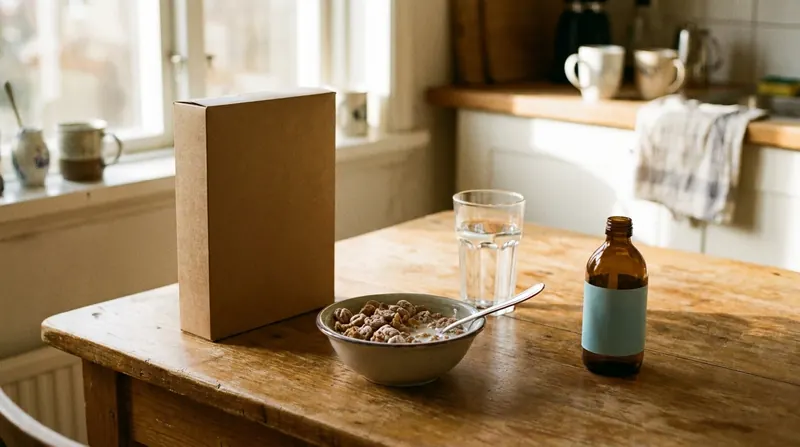
Start with the bowl.
A frosted, honey-coated or chocolate cereal is mostly refined starch and added sugar, and a serving can carry more sugar than a cookie.
No cereal "ages the brain faster than time."
Nobody has measured any such thing, and that phrase was written to be clicked.
What the studies do say is duller, and worth more.
In the Framingham Heart Study, adults who drank more sugary beverages scored lower on tests of memory, and daily fruit juice went the same way. [6]
In a Brazilian study of 10,775 adults followed for eight years, the ones who ate the most ultra-processed food, and the sweet cereal shelf is part of that, lost ground on tests of thinking about a quarter faster than the ones who ate the least. [7]
Both are associations across a population, not a sentence on your bowl.
And a quarter faster than slow is still slow.
A capsule of two ground herbs and nothing else is the one thing on this page the cereal shelf can't imitate.
The three drinks.
The "evening drink" in our advertisement is alcohol, and it's the one with the strongest case behind it: in 550 British civil servants followed for thirty years, the more a person drank, the faster their scores fell on a word-fluency test, and light drinkers had no edge over those who didn't drink at all. [8]
The second is sugar in a glass: soda, sweetened tea, the tall flavored coffee from the counter, which is a soft drink with coffee in it.
The Framingham finding above is about sugary drinks, and those are sugary drinks. [6]
The third, in one of our headlines, was coffee.
That was our worst headline.
Plain black coffee and plain tea aren't the drinks any of those studies were about.
Keep your coffee.
These capsules have no caffeine, and the maker's chart puts them at the other end of the day anyway.
The three foods.
Processed meat, fried food, and the white-flour shelf: pastries, packaged cakes, white bread.
Our advertisement says "just stop eating these three."
The research says something slower.
In 960 older adults followed for nearly five years, the ones whose meals looked most like the MIND pattern, vegetables, berries, nuts, whole grains, beans, fish and olive oil, held their thinking scores better, and the gap between the top and bottom thirds worked out to about seven and a half years of age. [9]
That's a pattern over years, not a list of three, and it can't be sold in a headline.
Which is exactly why our headline doesn't say it.
Leafy greens are on that list, and gotu kola is eaten as one in Sri Lanka, which is a better argument for a salad than for a capsule.
Less sugar in the bowl and the glass.
Less alcohol in the evening.
Keep the coffee.
Eat more like the Mediterranean shelf and less like the vending machine.
Every one of those costs nothing, and none of them is in the capsule.
The three words, or the three phrases.
There's no such list.
What our advertisement borrowed from is the short, scored mental-status test clinicians have given at the bedside since the 1970s: the date and the place, a few words to hold in mind and give back a minute later, a sum, naming, repeating one sentence, copying a drawing.
It's given in person and read against your age and your schooling by someone trained to do it, and a low score is a reason for a proper look, not a verdict.
Stumbling on a word when you're tired or being timed means nothing on its own.
Nothing begins at a word.
If the worry behind the click is real, that's fifteen minutes with your own clinician, and it costs you nothing from me.
And the advertisement about the things some men take every day.
That one sits closest to real research, and it's the one an advertisement has no business acting on.
Some kinds of daily medicine, including a few sold over the counter for allergies and for the night, are on the lists pharmacists check for people over 65.
Don't stop or change any of it because of an advertisement, ours included. Put everything you take in one bag, this bottle included, take it to the pharmacist, and ask one question: is anything here a poor choice at my age?
The maker's own chart says to consult a health practitioner; that's the same advice in fewer words.
The guide at the foot of this page has that section written out, with the studies.
So if you clicked on the cereal, here's where the cereal went: onto the table next to a bottle that has nothing to do with it, where the real answer was always a plainer bowl and a greener plate.
Line eight · What it isn'tSix Things Two Capsules Won't Do
- It won't give you the bacopa of the trials. Same 300 milligrams, but whole ground herb where the trials used a standardized extract, and no bacoside figure on the label.
- It won't give you the gotu kola of its one small trial. That used 750 milligrams of an extract; this is 300 of whole herb, and the pooled trials found no effect on test scores.
- It won't last the month at the maker's dose. Four capsules a day is twenty-two days from a bottle of ninety.
- It won't act on any condition a clinician has named. It's a dietary supplement, and its own label carries the sentence that says so.
- It won't go back. The seller accepts no returns except for a defect or a wrong order reported within fourteen days.
- It won't ship at no charge on its own. Shipping at no charge starts at the seller's order line, and one bottle is below it.
If that list annoys you, I'd rather you were annoyed now than when the bottle is empty in three weeks and the seller says no.
Line nine · The routineIf You Do Buy It: One Bottle, the Panel's Dose, Forty-Five Days, One Notebook
If you're going to spend the money, spend it as a test with a date on it, and take the panel's serving, not the chart's, so the test lasts.
- Ask your clinician or pharmacist before the first capsule, as the maker's own chart says. Two herbs are still two things you're adding to whatever you take.
- Buy one bottle, and take the panel's serving: two capsules once a day, with food. That's forty-five days, which is longer than the trials and long enough to know.
- Same meal at the same hour every day. The bacopa trials took twelve weeks to show anything; a capsule on the days you remember won't test it.
- Keep the coffee exactly as it was. There's nothing in the capsule to change your morning.
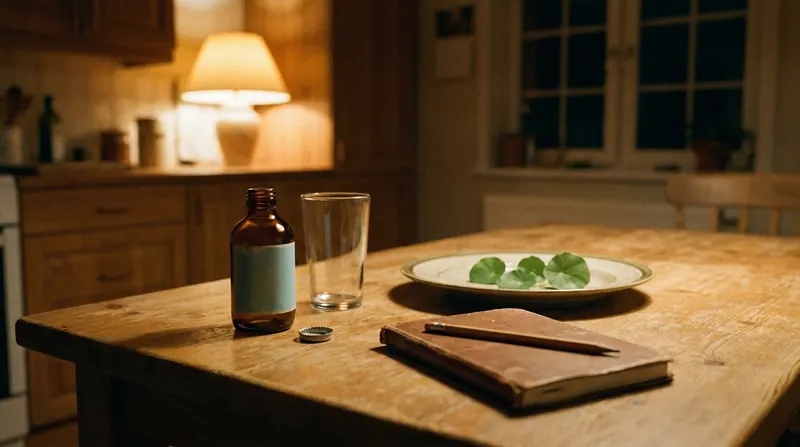
- Write one line a day in a notebook. Not "sharper" or "foggier." What you were doing at ten, and how it went.
- On day forty-five, read the forty-five lines. If they read better than the six weeks before, you've found a habit and can decide about the chart's dose. If they don't, you've spent the price of a bottle finding out, and there's no return to argue about.
Look at that list the way I do.
Four of the six things cost nothing.
The bottle is the one you'll pay for, and the clinician's word and the notebook are the ones that will do the work.

Line ten · Who it's forWho It Suits, and Who It Doesn't
This is worth a look if:
- You want two whole herbs with a long history, organically grown, and nothing else in the capsule, and you've now read how "whole herb" sits next to the extract of the trials.
- You'd rather take the plant than a concentrate, and you know the trade you're making.
- You want a certified organic company with a phone number in Colorado and an email. You have both now.
- You can hold two ideas at once: the cleanest label on the shelf, and no trial of this form at this dose.
- You'll buy one bottle knowing it can't go back, take the panel's serving, and run forty-five days with a notebook.
Give it a miss if:
- You want the bacopa of the trials. That's a standardized extract, and this isn't one.
- You want a bottle that lasts a month at the maker's dose. It's twenty-two days.
- You want something that acts on a condition a clinician has named. This is a dietary supplement.
- You want a refund if you don't like it. There are no returns.
- You take anything daily and haven't asked a pharmacist. The maker's chart says to ask; do that first.
Line eleven · Where it's soldFrom Boulder, Colorado, With Shipping at No Charge Above a Line and No Returns
The bottle is sold by Organic India on its own website, and that's the only place this page links to.

The company is easy to reach.
Organic India USA, LLC, with its customer-care team in Boulder, Colorado, a toll-free number that answers on weekdays, and an email; its terms name Boulder as its home, though no street address is printed on any page I read.
The bottle carries the USDA Organic seal, the Non-GMO Project mark and the B Corporation mark, which is more than most carry.
The current price is shown on its page, not here.
The day I read it, a bottle of ninety cost about what a good paperback and a coffee cost, which at the panel's serving is well under a dollar a day and at the chart's dose is a little over.
Buy one bottle, and decide which dose you're following before you divide the price by the days.
Now the two things that matter more than the price.
First, shipping.
Organic India ships within the United States by FedEx in four to eight business days; shipping costs nothing above the seller's order line, and a single bottle, the day I read it, was below that line, so expect a shipping charge unless you add to the order.
Second, the return policy.
Read this twice, though it's short.
As a standard, the seller accepts no product returns.
If the goods are defective or the order is wrong, you write within fourteen days of delivery and they replace it.
There's no satisfaction promise and no refund window for a bottle you tried and didn't like.
It's a clear policy with a real phone number behind it, and the answer is no.
I'd rather say so than call it a refund with no strings.
Everything in two capsules
| Ingredient | Amount per serving |
|---|---|
| Organic bacopa (Bacopa monnieri), whole herb | 300 mg |
| Organic gotu kola (Centella asiatica), whole herb | 300 mg |
| Other ingredients: organic pullulan capsule | — |
Full details on each ingredient are in the guide linked at the bottom of this page.
The ingredient and advertising guide linked at the foot of this page goes through both herbs and the capsule.
What each is.
What the research does and doesn't show, at what dose and in what form.
What to be careful about.
And which of our own headlines it does and doesn't support.
Print it and take it to the pharmacist if you take anything daily.
It's written for that.
See the current price on the seller's site
Two organic herbs from India, whole and ground, in a plant capsule, from a Boulder company that prints both doses and nothing else.
CHECK AVAILABILITYSold and shipped within the United States by Organic India USA, LLC, Boulder, Colorado · Shipping at no charge only above the seller's order line; a single bottle is below it · No returns except for a defect or a wrong order reported within 14 days; no satisfaction promise
QuestionsWhat Readers Ask Me Before Their First Bottle
Questions readers ask
Is this medicine?
No. It's a dietary supplement, two organic herbs ground whole in a plant capsule, from a company in Colorado.
The label carries the standard sentence every American supplement carries, the one that says the FDA hasn't evaluated its claims, and the little dagger after the three-word promise points to it.
Does it have caffeine?
No. Two herbs and a capsule.
The maker's chart suggests taking it in the evening, which tells you it isn't meant to wake you.
What's the difference between "whole herb" and the extract in the trials?
The trials used a standardized extract: the plant soaked and concentrated, with its active compounds, the bacosides, measured and set at a fixed percentage. This label is the plant dried and ground, with no extraction and no bacoside figure.
Same 300 milligrams, different thing, and no trial of this form at this dose in people over 55.
Which of the two herbs actually does something?
Neither meets its trial in form and dose. Bacopa matches the number and not the form.
Gotu kola's one small trial used 750 milligrams of an extract, and a meta-analysis found no effect on test scores. It's all on this page, line by line.
How long does a bottle last?
Forty-five days at the panel's serving of two capsules once a day; twenty-two days at the maker's chart of two capsules twice a day. Both are the seller's own numbers.
Will it help my memory?
I can't tell you that, and you should be wary of any page that does. No trial tested this form at this dose in people your age.
What the customers I kept describe is "I believe I can tell," a label they like, a slow year, "not enough on its own," and "hard to tell."
Can I take it alongside what I already take?
Ask your clinician or pharmacist and take the ingredient guide with you. The maker's own chart says to consult a health practitioner.
Two minutes at the pharmacy counter answers it.
Are the reviews real?
They're public on the seller's page and marked as confirmed buyers by its review system. That same system flags eight of the twenty-two as incentivized, and I've marked those the same way.
I quote them word for word.
Does it ship to me?
Within the United States, by FedEx, in four to eight business days. At no charge above the seller's order line; a single bottle is below it.
What if it arrives and I don't like it?
You keep it. The seller accepts no returns except for a defect or a wrong order reported within fourteen days.
There is no satisfaction promise.
Your advertisement was about a cereal, or three foods, or three drinks. Where is that on this page?
On line seven, in full, with the studies. The short version: less sugar in the bowl and the glass, less alcohol in the evening, keep your plain coffee, and eat more like the Mediterranean shelf, greens included.
None of it is in the capsule, and the ingredient and advertising guide at the foot goes through every headline we run and says which ones overstate.
Your advertisement said something about three phrases, or spelling three words. Is there a test I can take?
Not on a screen. The words and phrases come from the short mental-status test clinicians give in person, and it's read against your age and schooling by someone trained to do it.
Nothing begins at a word. If the worry behind the click is real, ask your clinician for the proper test.
It's fifteen minutes.
The short versionEverything Above, in Sixty Seconds
- A bottle of ninety plant capsules from Organic India of Boulder, Colorado: organic bacopa whole herb 300 milligrams and organic gotu kola whole herb 300 milligrams per two capsules, nothing else, no caffeine. USDA Organic, Non-GMO Project, B Corporation.
- Bacopa: the trials in adults over 55 used 300 milligrams of a standardized extract for twelve weeks; [1] [2] [3] this is 300 milligrams of ground whole herb with no bacoside figure. Gotu kola: one small two-month trial at 750 milligrams of extract, [4] and a meta-analysis that found no effect on test scores. [5]
- The maker's chart says two capsules twice a day, which makes the bottle twenty-two days; the panel's serving makes it forty-five.
- Twenty-two reviews, average 4.7, eight flagged as incentivized by the seller's system; the five I kept say "I believe I can tell," "nothing else," "over a year," "not enough on its own," and "hard to tell."
- Ships by FedEx within the United States, at no charge above the seller's line; no returns, no satisfaction promise.
- The cereal, three drinks, three foods and the word test from our own advertisements, on line seven: less sugar, less alcohol, keep the coffee, more like the Mediterranean shelf, and no test on a screen. None of it is in the capsule.
- The honest use: a clinician's word first, one bottle, the panel's serving with the same meal for forty-five days, and a notebook.
The last lineWhat Two Whole Herbs Are Actually Worth
Here's the whole thing in one breath.
Two real herbs from certified organic farms, ground whole and put in a plant capsule by a company that prints both doses and nothing else.
The bacopa at the weight of the trials and not in their form.
The gotu kola at less than half its one small trial, with pooled trials that came out even.
A dosing chart that turns ninety capsules into three weeks.
And a return page that says no.
If you're a man who wants the plants themselves rather than a concentrate, from the cleanest label on the shelf, and who'll pay for one bottle knowing it's a purchase and not a trial, that's worth the bottle.
Not because of the word on the front.
Because you'll know exactly what's in the two capsules, and exactly what the trials used instead.
Ask your clinician, buy one bottle, take the panel's serving with the same meal, and write one line a day for forty-five days. The notebook is a better judge than I am.
Check the current price and availability
Two organic herbs from India, whole and ground, in a plant capsule, from a Boulder company that prints both doses and nothing else.
CHECK AVAILABILITYSold and shipped within the United States by Organic India USA, LLC, Boulder, Colorado · Shipping at no charge only above the seller's order line; a single bottle is below it · No returns except for a defect or a wrong order reported within 14 days; no satisfaction promise
P.S. If you take one thing from this page, take the two numbers.
Three hundred milligrams of whole bacopa, the weight of the trials in a form the trials didn't use.
Twenty-two days, the life of the bottle at the maker's own dose.
Everything else about this bottle sits between those two.
P.P.S. If the afternoon fog has been with you for a year, and it's there before the coffee too, talk to your own clinician before you buy anything.
Two capsules with supper are a small habit.
They were never going to answer a question a clinician answers in fifteen minutes and a blood test.
P.P.P.S. And if you do order it, keep the notebook, and keep to one dose.
When the bottle is empty, you'll have forty-five lines about your own days, and that's worth more than the bottle, whichever way the lines turn out.